
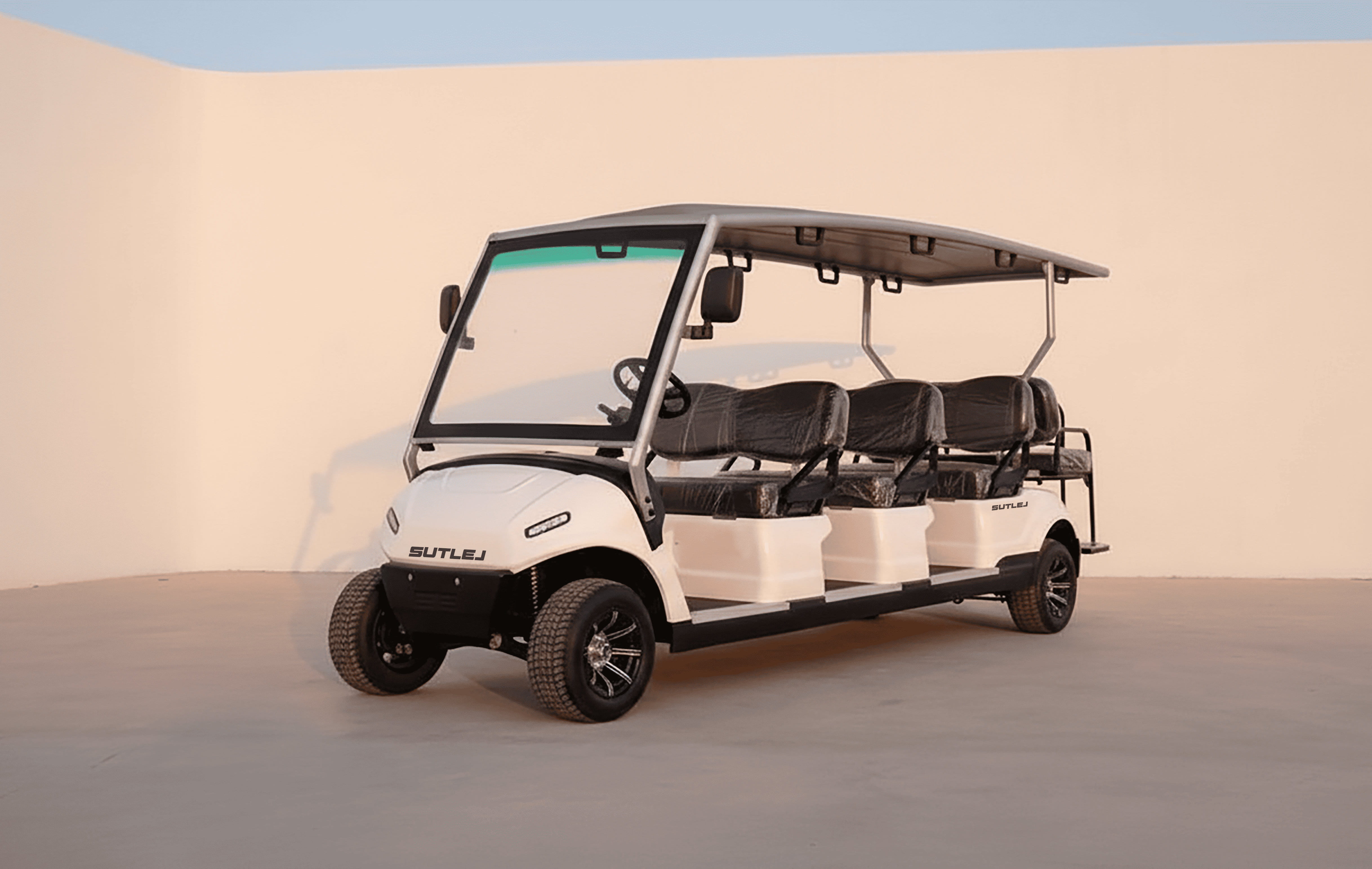
Choosing between a 4-seater and a 6-seater golf cart is one of the first decisions facility teams face when planning mobility for a large site. At Sutlej Automotives, we build electric golf carts for airports, tech parks, resorts, and industrial estates across India, and the pattern is consistent: the right seating size depends on how a space actually functions, not on a preference for more seats.
Why Seating Capacity Isn't Just About "More Seats = Better"
More seats don't always mean a better fit. Choosing between golf cart seating capacities depends on how you plan to use the cart day to day. A few practical factors should guide that decision:
- Corridor Width: Narrow corridors and walkways demand a smaller turning radius.
- Route Length: Short, frequent hops favour a compact vehicle, while long stretches favour a larger one.
- Passenger Flow: If the vehicle starts and stops more frequently, which size works best?
This is why an electric utility vehicle seating comparison should always begin with the site, not the seat count.
4-Seater Golf Carts: Where They Actually Win
Why Airports Use 4-Seaters for VIP and Staff Movement
Airport operations depend on precision. A 4-seater electric golf cart is built for exactly this kind of movement:
- Quick VIP escorts between check-in, lounges, and gates.
- Staff transfers across terminals without disrupting passenger flow.
- Fast response to last-minute gate changes, where speed matters more than group size.
For terminal teams that need agility over volume, this remains the preferred electric golf cart for airport use.
Maneuverability in Tight Terminal Corridors and Tarmac Zones
Airport corridors rarely run in straight lines. They curve around checkpoints, counters, and boarding gates, and a 4-seater electric golf cart is built to handle exactly that layout:
- Tighter turning radius for congested corridors.
- Smaller footprint on the tarmac, where ground crew share space with aircraft.
- Easier parking near gates without blocking passenger movement.
A smaller electric utility vehicle reduces the safety risk of moving larger vehicles through high-traffic zones.
Lower Per-Unit Cost vs Faster Turnaround on Short Routes
Short, frequent routes are where the 4-seater earns its keep:
- No wait time to fill seats, since a smaller e-cart vehicle can move the moment, it is needed.
- Faster cycles across short distances, matching terminal operations.
- Better fit for institutions that want to buy golf cart units for high-frequency, short-hop routes.
6-Seater Golf Carts: Where They Actually Win
Why Tech Parks Prefer 6-Seaters for Shift-Change Rush Hours
Tech parks face different challenges. Shift changes bring hundreds of employees through parking zones, cafeterias, and office blocks within a narrow window, and a 6-seater golf cart is designed for exactly this demand:
- More passengers per trip, reducing runs during peak hours.
- Smoother crowd movement across large campuses during shift-change rush.
- Consistent scheduling, since fewer trips mean fewer bottlenecks at pickup points.
For any golf cart for a tech park environment, shift-change efficiency is usually the deciding factor, and it shapes most of our tech-park golf cart recommendations.
Group Transport Efficiency: Fewer Vehicles, Lower Fleet Maintenance Overhead
A larger seating capacity simplifies fleet management too:
- Fewer vehicles to purchase and service across the campus.
- Fewer batteries to monitor and charge daily.
- Fewer drivers are required for the same number of trips.
Businesses working out how big a fleet they need will often find it makes more sense to use a blend of 6-seater golf carts. A thoughtful mix can also reduce fleet requirements without affecting service levels.
Handling Longer Campus Distances Without Multiple Trips
Corporate campuses often spread across wide layouts, with buildings linked by long internal roads. A 6-seater golf cart covers these distances in a single run, carrying an entire team from block to block without a second trip. In a corporate campus setting, this efficiency saves real operational time throughout the day.
What Airports Actually Choose: A Behind-the-Scenes Look
Most Indian airports do not rely on a single seating type. Their fleets typically combine both:
- 4-seaters for VIP escorts and gate-to-gate transfers that need speed.
- 6-seaters for baggage support teams and larger group transfers that need capacity.
- Weather-ready builds suited to the monsoon and the sharp summer heat across northern and western India, since carts must cross open tarmac stretches without slowing operations.
Choosing the right electric golf cart for airport use comes down to matching the vehicle to the task, not standardising on one size across the fleet.
What Tech Parks and Corporate Campuses Actually Choose
Matching Cart Size to Employee Density and Building Spread
Every tech park has its own layout and movement pattern:
- Dense IT corridors, such as Gurugram or Bengaluru, where buildings sit close together, often work well with 4-seaters for quick internal transfers.
- Sprawling corporate campuses with wide internal roads and multiple gates usually need the larger cart to move people across longer stretches.
This electric utility vehicle seating comparison is really a question of employee density mapped against layout, which is why we study a site closely before recommending a configuration for any golf cart for a corporate campus project.
Peak-Hour Bottlenecks: Why Some Campuses Mix Both 4- and 6-Seaters
Entry hours, lunch breaks, and shift changes place the heaviest load on any transport fleet. A single seating type rarely covers every route well during these windows, so a thoughtful mix of 4- and 6-seaters works better in practice. Facilities that build this 4-seater vs. 6-seater golf cart balance into their planning tend to see fewer delays at pickup points:
- Smaller carts handle quick hops between nearby blocks.
- Larger carts absorb heavier group movement during rush periods.
- Combined fleets reduce congestion across the entire day.
Campuses that plan around this balance consistently report smoother movement across the day, which is exactly what a best golf cart for institutional use setup should deliver.
Final Verdict: When to Choose 4-Seater, 6-Seater, and When to Mix Both
No single answer exists in this golf cart seating capacity comparison, and any experienced custom electric golf cart manufacturer will tell you the same.
| Choose | When |
|---|---|
| 4 Seater Electric Golf Cart | Speed and frequent short trips through tight spaces, such as airport terminals or compact office layouts |
| 6 Seater Golf Cart | High-volume movement across longer distances, such as tech park shift changes or corporate group transfers |
| A Mix of Both | Campuses with peak-hour bottlenecks that need both agility and group capacity |
For many facilities, the smartest approach is a mix guided by an accurate golf cart fleet size for business assessment and a plan that matches each cart to the route it actually serves. That approach, more than any single spec, defines the best golf cart for institutional use.
Plan the Right Electric Golf Cart Fleet with Sutlej Automotives
At Sutlej Automotives, we work as a custom electric golf cart manufacturer that studies your site before recommending a fleet, whether that means a lean set of 4-seaters, a group of 6-seater golf cart units, or a combination built around your real foot traffic. Beyond golf carts, our range of mini electric vehicles and electric utility vehicle solutions gives institutions across India a complete mobility answer, backed by nationwide after-sales support. Campuses increasingly choose our mini electric vehicles for lighter, agile transport alongside a standard fleet.
If you are ready to plan a fleet that fits how your people actually move, reach out to our team for a consultation. Whether you want to buy golf cart units for a new airport terminal or upgrade a tech park fleet, we will help you choose the right seating mix, the right e-cart vehicle configuration, and a maintenance plan built for your institution.
Get in touch with Sutlej Automotives today and build a fleet designed around how your campus actually works, not just how many seats it has.

Sutlej Automotives
Driving Sustainable Mobility in India


