
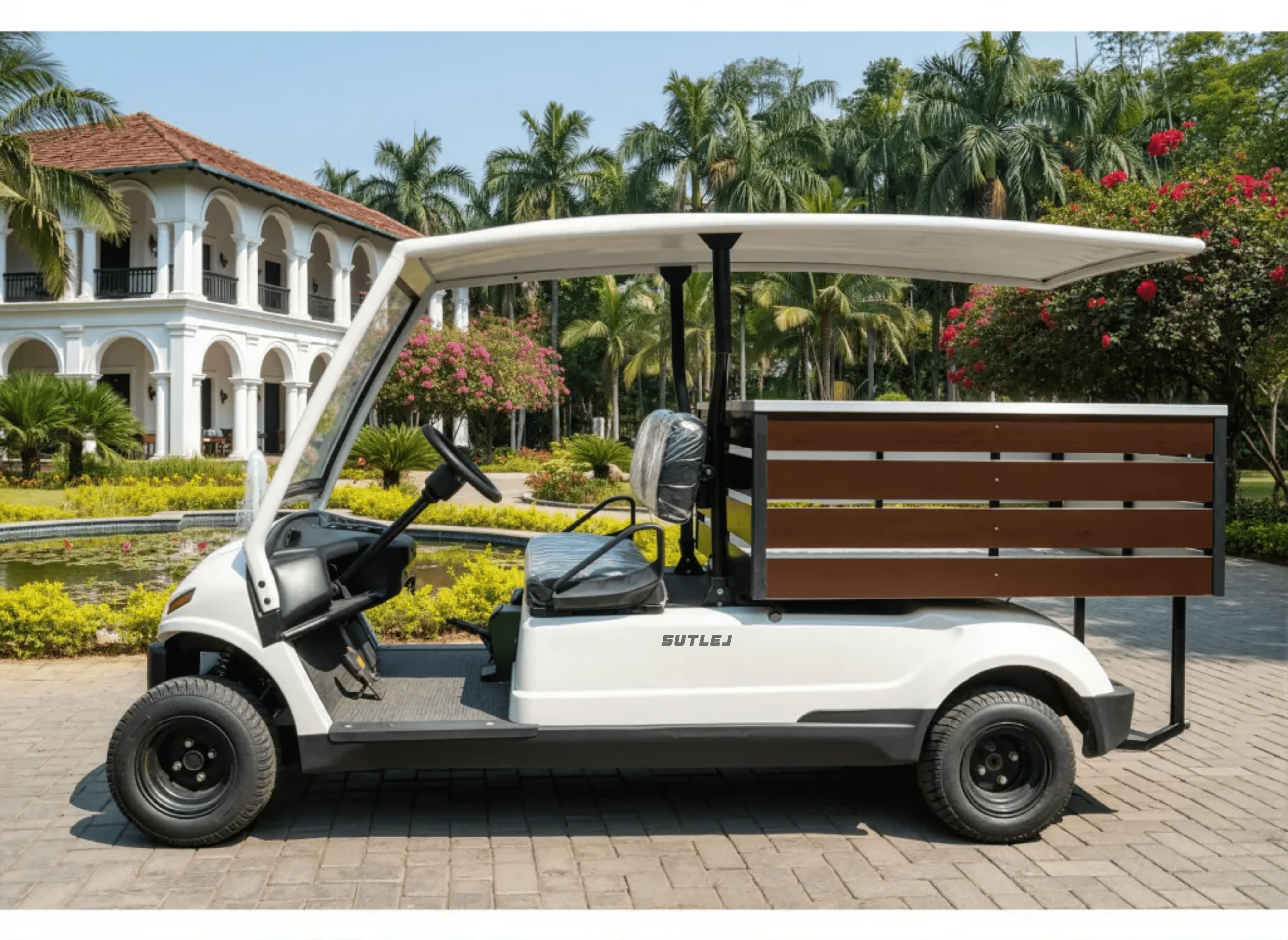
Most of what moves across a factory floor travels short distances, not up onto a rack. Yet the forklift is usually the only vehicle available, so staff end up waiting on it even for a small consignment moving from one shed to the next. On industrial estates across Punjab, where plants often sit on wide campuses through both foggy winters and humid monsoons, this mismatch shows up in lost time every day.
A cargo golf cart solves that specific problem, without competing with a forklift. Built by a cargo cart manufacturer India trusts for factory-grade durability, it is a multi-purpose electric vehicle designed for the short, repetitive trips that fill most of a factory's internal movement.
What a Cargo Golf Cart Actually Offers That a Forklift Doesn't
As an electric utility vehicle built specifically for factory conditions, a cargo cart fills the gap between walking a load by hand and calling in a forklift for a job that does not need one.
Load Capacity and Payload: Where Carts Hold Up and Where They Don't
A forklift lifts and stacks pallets several feet into the air. A cargo golf cart was never built for that. It handles a steady stream of moderate loads across flat ground, run after run, without slowing at every dock or turn. If your daily movement is mostly components, packaged goods, or supplies rather than stacked pallets, an electric cargo cart for factory use can handle the job without strain. Vertical lifting still calls for a forklift, but once a plant tracks its actual floor movement, most of the rest turns out to be short-haul material-handling territory.
Manoeuvrability in Tight Aisles, Docks, and Mixed-Use Floors
Aisles on a working floor are rarely wide. Machinery, racks, and people on foot close them in quickly, and a forklift needs real clearance to turn safely. A cargo cart is compact enough to steer through that same space. As a factory-floor transport vehicle, it moves comfortably where docks are tight, and pedestrians, machines, and vehicles share the same lanes, reducing near misses and keeping nearby work from stopping.
Operating Cost Per Trip: Electricity, Maintenance, and Tire Wear Compared
Diesel and LPG forklifts have running costs that add up daily: fuel, frequent servicing, and parts that wear out faster under heavy lifting. An electric utility cart for industrial use runs on a rechargeable battery, so each trip costs far less than the same trip on fuel. Fewer moving parts under strain means less time off the floor for repairs, and tyres last longer because a cart never carries the weight that wears down a forklift's tyres. This makes it a genuinely low-cost material-handling choice for plants running frequent short trips.
Operator Training and Licensing Differences
A forklift needs a properly trained, often certified operator, given the risk of lifting heavy loads at height. A cargo golf cart, as a lighter electric utility vehicle, requires far less, and staff can be trained on one quickly. This matters whenever a factory needs to shift people between roles or bring in temporary help quickly.
Where Forklifts Still Win (Being Honest About the Trade-Offs)
The honest way to settle the cargo golf cart vs forklift question is to admit a cargo cart cannot do everything a forklift does. Forklifts remain the right call wherever a task genuinely needs vertical lifting or heavy stacking, even against a low-cost material-handling option like a cart.
| Factor | Forklift | Cargo Golf Cart |
|---|---|---|
| Primary strength | Lifting and stacking heavy pallets | Carrying moderate loads over short distances |
| Best suited to | Warehousing and vertical storage | Assembly lines, campuses, factory floors |
| Space required | Wide aisles, full turning radius | Narrow aisles, mixed-use floors |
| Running cost per trip | Higher, tied to fuel and servicing | Lower, tied to electric charging |
| Operator training | Formal certification needed | Minimal training needed |
Choosing between the two is not about picking a winner. It is about matching each vehicle to the job it suits, which makes a cargo cart a workable forklift alternative for warehouses handling frequent, lighter loads.
When Factories Made the Switch to Cargo Golf Carts
Moving Components Between Assembly Lines
Where several assembly lines run close together, parts need to move constantly between stations. This is ideal territory for an electric cargo cart for factory use, doubling as a material-handling vehicle for short-haul work wherever a line waits for its next part. Instead of waiting for a forklift to free up, staff use a cart that stays available and moves easily between lines without holding up production.
Internal Logistics Across Large Industrial Campuses
Industrial estates across Punjab often stretch across large campuses, with warehousing, production, and dispatch kept well apart. Covering that ground on foot adds up fast over a shift. Serving as a reliable electric cart for warehouse logistics, an electric utility cart for industrial use keeps goods moving steadily between buildings without the noise or exhaust of fuel-powered transport, and keeps working through the region's humid monsoons and dry summers alike.
Reducing Congestion and Safety Incidents on the Factory Floor
Fewer forklifts moving through crowded areas means fewer chances for a serious incident. A cargo cart, being lighter and slower by design, lowers the risk of heavy machinery sharing space with people on foot. As a commercial electric vehicle and a ready-to-use factory-floor transport, it can improve how a factory floor feels within weeks of being put to work.
How to Decide Which One Your Factory Actually Needs
Settling the cargo golf cart vs. forklift question for your own floor turns a general electric vehicle purchase into the right one. Ask a few direct questions about how it actually runs.
- What is being moved, and over what distance each time?
- Does it need to be lifted and stacked, or simply carried point to point?
- How tight are the aisles and docks the load has to pass through?
- Would the floor work better with one heavy-duty machine, or several mini electric vehicles covering different zones at once?
Where most daily movement is short-haul and low-lift, a lighter vehicle covers the job more efficiently than a forklift used for work it was never designed around, making it a straightforward forklift alternative for warehouses in that position. Where the work genuinely needs vertical lifting, the forklift still earns its place.
Making the Right Call for Your Factory Floor
No two floors move goods the same way, so there is no single right answer. What matters is looking honestly at how material travels through your site and choosing a commercial electric vehicle that matches that pattern, instead of defaulting to whatever is already parked in the yard.
Sutlej Automotives builds its electric cargo carts, the 2S, 4FF, and 6FF models, for this kind of everyday movement across Indian factories, warehouses, and industrial campuses. As a cargo cart manufacturer India trusts for Punjab's foggy winters and humid monsoons alike, Sutlej builds each cart as a genuine multi-purpose electric vehicle, with a rust-resistant body, weather protection, and hydraulic brakes meant to perform through daily use, not just survive it. Whether your floor needs mini electric vehicles for a single zone or a small fleet across a campus, Sutlej has the right range.
If your factory floor is ready to move goods smarter, contact Sutlej Automotives for a free quote and find the electric vehicle for business and the electric cart for warehouse logistics that fit how your operation runs.

Sutlej Automotives
Driving Sustainable Mobility in India


