
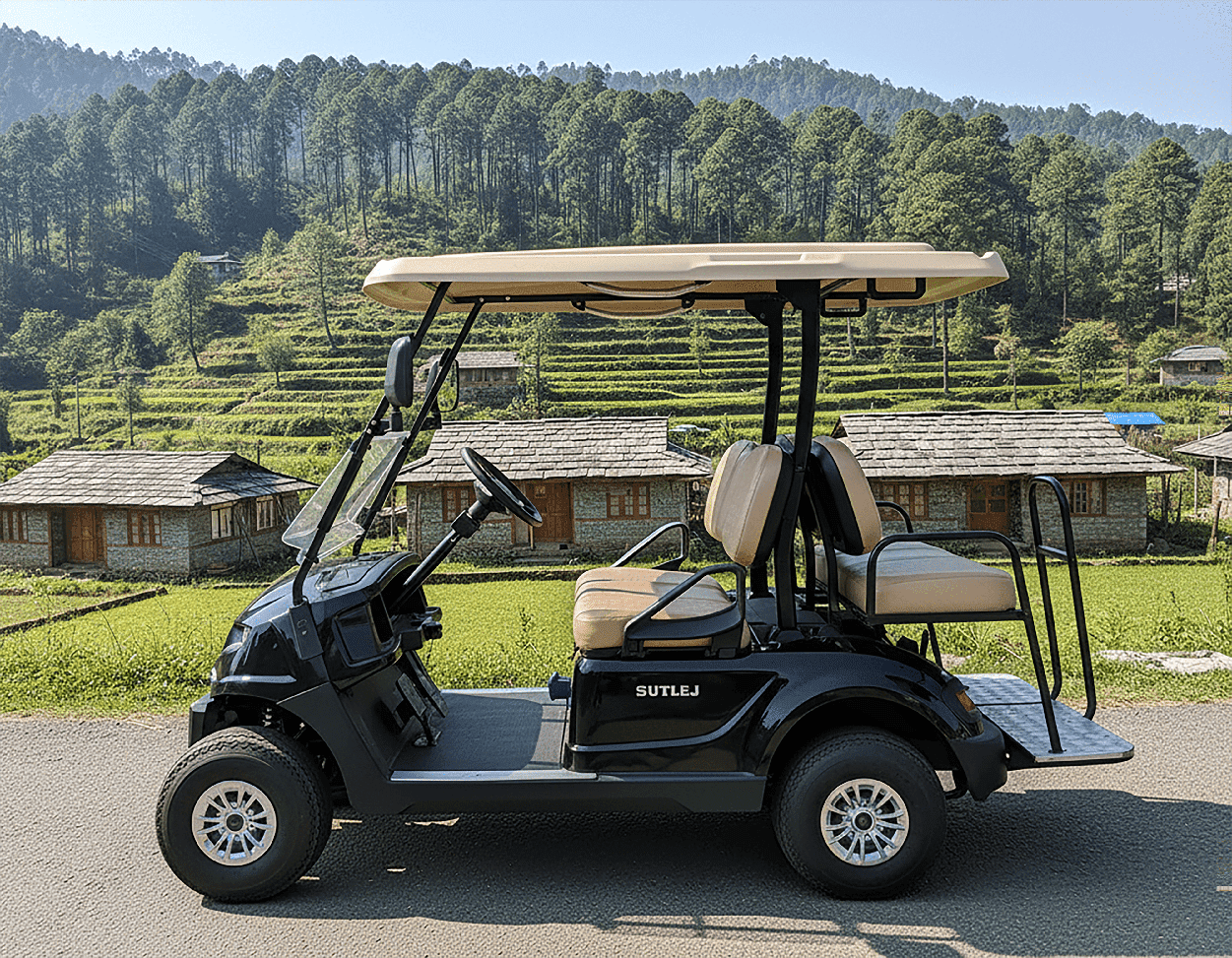
A resort golf cart wears out faster than a campus golf cart, and the reason has nothing to do with build quality. It comes down to how differently the two fleets are used every day. Before you buy golf cart units for a resort, it helps to understand exactly where that extra wear comes from, and what a fleet built for resort conditions actually looks like.
Sutlej Automotives has manufactured electric golf carts and utility vehicles for over 90 years, supplying campuses, resorts, hotels, temples, airports, and industrial estates across India. Working across this many settings makes it easy to see why one usage pattern is harder on a vehicle than another.
What Actually Wears Out a Golf Cart Faster
Electric golf cart lifespan by usage type comes down to four factors: how the cart is driven, who drives it, what it carries, and how it gets charged.
Duty Cycle: Constant Stop-and-Go vs. Steady Campus Loops
- A campus cart runs one route with long, even stretches and minimal braking.
- A resort cart starts, stops, reverses, and idles through the day, often within a few minutes.
- Frequent starts and stops put far more load on the motor and brake system than a steady loop does.
- Golf cart wear and tear at resorts vs. campus often starts here, before any other factor comes into play.
Driver Turnover: Guests and Valets vs. Trained Staff
- Campus carts stay with the same small group of trained staff.
- Resort carts pass between valets, bellhops, and sometimes guests.
- Each driver brakes, accelerates, and turns a little differently.
- This turnover is one of the more overlooked resort golf cart maintenance problems, since no single driver is accountable for how the vehicle gets handled.
Load Variability: Luggage, Golf Bags and Passenger Swings
- A single guest with light bags is one trip.
- A family with luggage and golf equipment is the next.
- Suspension and tyres absorb these load swings, trip after trip.
- Campus carts rarely see this kind of variation, since passenger count barely changes from one ride to the next.
Charging Habits: Partial Charges Between Back-to-Back Shifts
- Resort carts get plugged in for short bursts between shifts.
- They go back into service before the battery finishes charging.
- Repeated partial charging is one of the more common causes of golf cart battery drain during heavy use.
- A full overnight charge, the kind campus carts usually get, keeps the battery in far better condition.
The Real Math: Cost Comparison of One 12 Seater vs Three 4 Seaters
Splitting guest movement across several smaller carts feels efficient on the surface. In practice, it usually adds more points of failure than it removes.
| Factor | One 12 Seater | Three 4 Seater Golf Carts |
|---|---|---|
| Systems to maintain | One drivetrain, one battery | Three drivetrains, three batteries |
| Charging coordination | One charging cycle | Three overlapping cycles |
| Driver requirement | One trained operator | Multiple drivers, varying skill |
| Effect of one breakdown | Backup capacity usually available | A third of total capacity lost at once |
A single larger vehicle, such as a 12-seater electric shuttle, reduces the number of parts needing regular service and the number of drivers to manage. Fewer systems in the field also means fewer places for something to go wrong quietly between services. Resorts weighing electric minibus price options against smaller carts often find one larger shuttle simpler to run and maintain.
Resort-Specific Stress Factors Most Buyers Don't Consider
Terrain Changes: Gravel Paths, Inclines and Wet Grass
- Resort properties are rarely built on one uniform surface.
- A single trip might cover gravel, a slope, a paved path, and wet grass.
- Each surface change strains tyres, suspension, and motor output.
- Most buyers only notice how terrain affects a golf cart's lifespan after a full season.
Extended Idle Time in Heat: Battery and Electronics Impact
- Carts left parked in direct sun face real heat stress, even with the engine switched off.
- High temperatures affect battery cells and onboard electronics over time.
- Resorts in warmer parts of India see this more than properties in cooler regions.
- Stronger battery management built into the cart itself is what limits the damage here, not where the cart happens to be parked.
Higher Daily Mileage During Peak Season
- Resort carts cover far more ground during peak season than campus carts ever do.
- Larger properties across hill stations and coastal areas add to this daily distance.
- Higher mileage wears down components faster when the vehicle was not built for that level of daily use.
- Golf cart usage cycles explained this way make it clear why mileage alone can shorten a fleet's working life.
How Campus and Institutional Carts Get an Easier Life
Predictable Routes and Flat Surfaces
A campus cart runs the same paved route every day. That alone puts far less strain on the drivetrain and suspension than a resort's mixed terrain.
Trained Operators Reduce Mechanical Abuse
A small, consistent group of drivers means steadier handling and fewer accidental knocks. Commercial golf cart durability holds up better under this kind of routine.
Consistent Charging Schedules
Most institutions charge their fleet overnight on a fixed schedule. That gives the battery a full, uninterrupted cycle instead of the partial charging typical of resort use.
How We Engineer Carts Differently for High-Duty Environments
Sutlej Automotives builds each electric golf cart around its intended use, not around a single standard design. For resorts and other high-duty properties, our range includes:
- Electric golf buggy and mini electric vehicles for short transfers within the property.
- A 4-seater or 6-seater golf cart for regular guest movement.
- Electric shuttles for larger groups on bigger layouts.
- Electric cargo vehicle and electric cargo options for moving supplies, linen, and equipment between blocks.
- Electric utility vehicle and e-cart vehicle models for staff and operational use.
Every vehicle in this range is built to the same standard: quality materials, reliable batteries, and current manufacturing technology, so durability does not drop just because a vehicle is smaller. Most resorts run more than one of these at a time. A 4-seater golf cart can stay on guest pickups while an electric cargo vehicle handles housekeeping and maintenance runs, so the two never compete for the same charging point. Pairing the right electric golf buggy, mini electric vehicles, or electric shuttles with each task keeps pressure off any single vehicle in the fleet.
Choose a Fleet Built for How Your Resort Actually Runs
Golf cart fleet breakdowns rarely trace back to one faulty vehicle. They trace back to a fleet that was never matched to the property's actual routine in the first place. Sutlej Automotives has built electric golf carts for campuses, resorts, hotels, temples, and airports across India for over 90 years. If you are comparing the best golf carts for resorts India has to offer, that experience is exactly what goes into matching the right vehicle to your terrain, guest volume, and season.
Whether you plan to buy golf cart units for guest transport, add a 6-seater golf cart for group movement, or bring in an electric utility vehicle and e-cart vehicle for staff use, our team can help you reduce golf cart downtime resort-wide. Call Sutlej Automotives or book an enquiry online to discuss the right electric golf cart, electric shuttle, or electric cargo vehicle for your property. Our team will schedule a call, go through your requirements, and recommend a fleet built for how your resort actually runs.

Sutlej Automotives
Driving Sustainable Mobility in India


